Tuesday, December 1, 2020

The 12 Days of Christmas in the South ...

It's getting close to Christmas and I thought it might be helpful if I shared with you an adaptation of that old seasonal favorite, "The 12 Days of Christmas." So before you get "Lords a leapin'" and "Golden Rings" stuck in your head for a week or so, check this list out to see how this works in the South...

12 Chickens fryin'

11 footballs flyin'

10 porch swings swayin'

9 preachers prayin'

8 hunters huntin'

7 pick-ups honkin'

6 biscuits bakin'

5 mason jars for drinkin'

4 fireflies glowin'

3 jugs o' sweet tea brewin'

2 "Bless yo Heart, darlin'"

and ...

a blossom in a Magnolia Treeeeeeeee.

This is just another part of my education upon moving to North Carolina.  So far, we have really enjoyed this major, major change in our lives -- especially at our advanced age. If you would like to review some of the things I have already learned following our move, pull up my entry from January 30, 2020 ("Time for a little culture, y'all")

“Did you ever notice that life seems to follow certain patterns? Like I noticed that every year around this time, I hear Christmas music.” (Tom Sims)

Hooah

Tuesday, November 24, 2020

"Band of Brothers Adventure" Day 3 -- NORMANDY, Part 6 (Brecourt Mannor, Sainte-Mère-Église ) ...

It was just a short jaunt over to the farm known as Brecourt Mannor, the place where the Germans had several big guns situated that overlooked the landing areas on the beaches.  This farm, the German guns and their destruction by Easy Company, 502 PIR, was highlighted in the HBO min--series, "Band of Brothers."  I have watched this series so many times I wore out the one that my old Sergeant-Major gave me and had to buy another set of discs.  As is shown in the pictures below, this area has pretty much been preserved as it might have been then.


The monument to the right was erected when the men from Easy Company came to visit this field again. The guide that the tour company (Beyond the Band of Brothers) hired (various subject matter experts for each of the stops on the tour) went into great detail explaining the placement areas for the guns, and how the men of Easy Company took them out.  There has been a lot written about this and it was subsequently used by Army as a model for small unit tactics.  Google this and there will be lots of articles, books, maps and videos of terrain walks for your review.

Following this stop, we headed out for Sainte-Mère-Église.  This was really a great place to see and take in the history of what happened to the Airborne troops that assaulted this area. There is an 82d Abn.museum in the city and there were really interesting exhibits, including a WACO glider which was manufactured in Troy, OH. Again, this is one of the things that would be worth your while to Google as there are tons of documents, pictures, maps, and stories surrounding this assault.  Below are some of the pictures I took highlighting just a few of the things to see here.

Men attending mass in this church.

The church today.

A stained glass window in the church.  Notice the 82d emblem in the upper left and the parachute at the very top. Enlarge this picture and see all the various airborne images the people put in it. I think I remember someone in the church telling me that the person in the middle of the window is supposed to be the patron saint of paratroopers.

This is a vigil stand.  You light one of the candles and say a prayer for someone or something.  I lit two of the candles -one for my dad, and one for my brother-in-law, Chuck (third row up from the bottom, far left).

My dad was artillery during the war, so I checked out this piece.  He was not in the 82d, but I remember him telling me he fired big howitzers, much bigger than this one.

This is the outside of the church at Sainte-Mère-Église.  You can see the outside of the window shown above.  The white item caught on the spire of the church is a representation of John Steele, a paratrooper whose chute caught up on it during the assault. Originally, this was on the other side of the church (historically correct), but tourists didn't see it there, so they moved it to this side. Google this too.  It's interesting.

Keith and I had a great lunch here, and the beer was really pretty good. So this was a pretty busy day and now it's off to Bastogne.

Click on this link for some more info on this site.  Follow-up link. 

 “People sleep peaceably in their beds at night only because rough men stand ready to do violence on their behalf.”  (George Orwell)

Hooah

Monday, November 23, 2020

"Band of Brothers Adventure" Day 3 -- NORMANDY, Part 5 (American Cemetery at Normandy) ...

Our next stop was at the American Cemetery at Normandy.  I was so looking forward to seeing this piece of ground, but was not ready for what I saw.  We got off the bus and walked down a little drive and the first thing I saw was the statue shown below.  And then I looked to the left and that sight almost took my breath away.  White crosses for pretty much as far as you can see, at least to the edge of the cliffs at the ocean side. If you did any homework before going here, and if you know anything about what took place on the beaches below and the surrounding countryside, seeing this place and walking among the first few rows, it's like a gut punch. The overwhelming weight of this sight demands that you stop, take a deep breath, and remember that each of these 9,385 markers was a person, a person who fought to keep us free, who fought against unimaginable horrors.  The exact precision in which the crosses are lined across the field is a stark contrast to the chaos of those battles.  But beyond all of that, it is just overwhelming knowing that each of these markers was a human being. Over the next few days, we were to see several cemeteries like this one, but this one woke me up.


I was surprised to find, as I walked around, that there are actually quite a few markers that indicated that the soldier buried there was unknown -- 307 Unknowns.  I didn't know that prior to going there.

The Normandy American Cemetery is located in Colleville-sur-Mer.  It is situated on 172.5 acres and contains the graves of 9,385 of our soldiers.  There are 1,557 names on the wall by the statue denoting those who were missing in action, and there are 45 sets of brothers buried here.

As enormous and overwhelming as this place of honor was, it's hard to know that this wasn't all of it -- all of the war that was to consume and destroy a continent. 

"Our flag does not fly because the wind moves it. It flies with the last breath of each soldier who died protecting it." (Unknown)

Hooah

(P.s. Here is a picture of the first burial place for Soldiers killed at Normandy.  Didn't last long ans it quickly became overcome by sheer numbers.)


"Band of Brothers Adventure" Day 3 -- NORMANDY, Part 4 (Walking the grounds) ...

After spending a great deal of time on the beaches and seeing the big German guns on the cliffs above the landing area, we spent some time over by the areas where the Rangers came up the cliff at Point du Hoc.  What they managed to do was absolutely unbelievable.  I went to the edge of the cliffs and looked down, just as the German defenders might have.  The fields of fire the Germans had presented such a dangerous mission for those Rangers. I don't know how all of this went down, but at some point the big guns of the Navy played an important role, shelling the German guns on the cliffs, paving the way for the invading Americans and Allies.

This picture shows the view out of a gun emplacement over the cliffs.
 

The two pictures above give you an idea of just how formidable that shelling must have been.  I'm viewing this some 60 years after the war, so the craters have filled in some with the elements and time, but as you can see, this terrain was just destroyed and to a great extent hasn't grown back.  I walked down into the center of a couple of them and they were still more than 15-20 feet deep and around 10-12 yards wide.  Also, these craters were literally right next to each other.  The paths that are in the bottom picture led from one crater to another.  I know this picture doesn't do justice to the actual size of this area and the damage that was done.  Perhaps you can go some other place on line and get some better pictures.

"It was a different world then. It was a world that required young men like myself to be prepared to die for a civilization that was worth living in."  (Harry Read, British D-Day veteran) 

Hooah 

"Band of Brothers Adventure" Day 3 -- NORMANDY, Part 3 ("Then and now") ...

Quite a while ago, a friend of mine (Keith) sent me a power point presentation that showed pictures of Normandy as it was during the war, and as it was at the time these pictures were taken (not sure of the date).  This was kinda the spark that led to this trip.  Thought you would like to see it and I really wanted to show that particular one.  BUT, I was not smart enough to figure out how to get a power point presentation linked to this entry. I'll keep trying.  Maybe my friend Dave will be able to tell me when he reads this.

I'm not sure this video will be the one to come up each time. But, again, you are looking for the one that is titled "Normandy, then and now."


Also, please feel free to skip the ads that might pop up.  Don't know how to edit them out.Also, I hope there is nothing that is inappropriate that might pop up.  If this becomes a problem, I might delete this entry.

Regardless, this was quite a trip.  Seeing the places where my father might have walked was quite an experience.

“The true soldier fights not because he hates what is in front of him, but because he loves what is behind him”

Hooah

Wednesday, May 20, 2020

"Band of Brothers Adventure" Day 3 -- NORMANDY, Part 2 (Beaches) ...

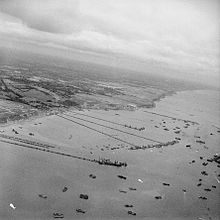
After exploring the gun emplacements, we worked our way down to the area overlooking Gold beach and could look at some of the remaining barges that were placed out there in the ocean to serve as an unloading dock for all of the logistics of the war. In this picture below, you can see some of the remaining Mulberry Artificial port. (The black and white picture is a war photo of the beach area during the invasion).
The Mulberry artificial harbour off Arromanches in Normandy, September 1944. BU1024.jpg

 
 This plaque depicts the cliffs at Cherbourg.

The plaque shown here gives you a one-over-the-world view of the layout of the beaches and areas of responsibility.  To get a better grasp of this area, click on it to enlarge the picture.
So following this, we worked our way down to the actual beaches.  My dad's artillery unit came ashore here so this was a must see portion of our trip.  Once we got to the beach itself, I just had to take off my shoes and walk out into the water, the same water where so many came ashore and where so many men lost their lives for our freedom.  As you can see from the picture, the beach barriers and impediments are gone, and the tide is out.  No one is shooting at anyone so I decided to start walking out to get an idea of what their distances might have been.  Again, if you click on these pictures, you can get an idea of how far I went out before I got to water.


Once I got here, I turned around and stared back at the beach area.  It's absolutely unbelievable that they went that far into the blistering fire of the Germans.  As soon as the front gates fell on the landing craft, there was nothing between them and the enemy guns. I took this picture of a house on the beach that I think was a part of the Band of Brothers mini-series.  The guides tell us that it wasn't used that way, but it sure would have been a good place for a machine gun (at least until the first naval fire started).
Supposedly the open window in the left on the second floor is where the Germans had set up their guns. Then I just had to take another picture of that "guy" in the shadow.  Looks a little different on the beach.

"They had come to win.” They hadn't come here to fear. They hadn't come to die. They had come to win.”  (Stephen E. Ambrose)

Hooah 

P.S. I forgot to put in here a couple of pictures that really highlighted the difficulty Americans and the Allies had storming the beaches and working inland.  They also highlighted the preparations the Germans had taken to stop or at least make it very difficult for the Americans to get off those beaches.

These are pictures of machine gun emplacements built into the side of hills bordering the road leading from the beaches. Granted there has been a great deal of growth of underbrush over the years, but they were really pretty hard to pick up and they look pretty well-built.

I know it is hard to see but this gun emplacement is shown pretty much in the center of this picture, about 1/4" down from the top (the little dark spot).Hard to see and even harder for the GIs to take it out.

This gun emplacement is in the middle of the big concrete wall just above the chimney.  It is losing some of its surrounding ground but was an extremely well-built gun port with a field of fire straight up the road from the beach.  Troops would move up the road and past the machine gun before the Germans would open up on them. 
 
These were just two of the ones that I got pictures of, but the guide told us that they were dispersed all over the sides of the hills and cliffs.


"Band of Brothers Adventure" Day 3 -- NORMANDY, Part 1 (Gun Emplacements) ...

OK.  This day started off in a little bit of a rush.  Seems we forgot to set our alarms correctly and we just happened to wake up at the same time we were supposed to be checking out of the hotel and getting on the bus for our drive to Normandy.  Miss the bus and you have to arrange for your own transportation to the next stop.  Wonder what a French cab would cost for the trip from Caen to Normandy ?  Well, no need to worry -- we made it, no showers, no breakfast.

(Note: On all of these pictures of this trip, please click on the picture to enlarge it otherwise a lot of the details will go unseen.)

Once we got to the cliff area overlooking the beaches, this is what we saw...looked pretty much like any other farmer's wheat field.  The gun emplacements probably would have been pretty hard to pick up from any great distance.


As we walked up closer to them, I was amazed by their size and the fact that there are as many still standing as there are.  I have read that the Germans had a special mixture of concrete that they used on these emplacements and other areas like the Maginot Line, Hitler's bunkers, etc. I guess the reason I am amazed they are still there in this quantity is that I know the power of the shells the Navy hit them with.  I guess also that the armies that attacked the beaches fought through these so quickly (relatively speaking).


Something our guide pointed out was the small little indented areas on the tops and sides of the gun emplacements.  Most people who have never studied these think that these are marks from the shelling.  Actually, these were small areas where the Germans put grasses and bushes in order to break up the silhouette of the structure.
We spent the better part of the morning here and walked in, over, and through these testaments to history.  One that stuck out in my mind was featured in the movie "The Longest Day" when the German officer was looking out through the opening, out toward the sea and saw the armada of  Allied ships coming toward the coast.  I forget what expletive he used, but I know what I would have said.
Standing in his exact spot, and seeing that awesome fleet -- I probably would have needed a new pair of underwear!!  I was trying to refrain from saying "You have to see it to believe it" but that certainly is the case. I have seen a lot of things in the Army, but nothing like this would have been.

When you are on these tours, you have to pretty much carry a back pack with you because you cover so much ground and if you need any snacks (remember we missed breakfast) or water, the buses are nowhere to be seen.  So, as I was taking pictures of all of these things, I just happened to take this one of me with my back pack.  I thought it looked like a soldier from long ago walking these grounds. This was taken just at the edge of the cliff where the Rangers came up. Unbelievable.
So now it is on to the next part of the morning's experience.  From here we went to the area overlooking the beach where the Brits landed and where the "Picadilly Circus" was located and then on to Omaha Beach.

"They fight not for the lust of conquest. They fight to end conquest. They fight to liberate." (President Franklin D. Roosevelt)


Hooah