Saturday, January 7, 2017

The Battle of Tawawa Woods...

This past September, the Shelby County Historical Society and the City of Sidney sponsored a weekend of Civil War reenactments, period music, and educational events at the Tawawa Park.  I have spent a great deal of time studying the Civil War from a military prospective.  My wife and I have walked battle fields (Gettysburg twice), stayed at period bed and breakfast establishments, and I have read more books about the subject than I can count.  When I was in the Army, one of my battalion commanders who had a similar interest in that war from a military perspective, took his whole battalion staff on a battle field terrain walk.  We studied the tactics and how terrain, populations and logistics had different impacts on various battles (Richmond, Bloody Angle, Gettysburg, etc.).  That was quite a treat for all of us young officers.  As a much younger E-5 Sergeant, I took part in a Civil War Color Guard which traveled around to events a number of times.  Later in my military life, I even had an opportunity to walk the grounds of the Andersonville Prison Camp. 

So, when this event was advertised, I could not wait.  Knowing the director of the Historical Society, I knew she would make this a first rate event.  As the date got closer, the weather forecast got worse -- go figure.  All those people who thought that that particular war might have been fought in the sunshine were given a wake-up call.  It rained pretty much most of the weekend, off and on. I thought it was great.

So on Saturday afternoon, the "Yanks" and "Rebs" conducted a battle which the director called "The Battle of Tawawa Woods."

As the combatants took the field, the Union forces, under the command of General Burnside, attacked from the right, across the woods in a frontal assault against an assembled Rebel force.

However, the tide of battle soon turned and the Yankees withdrew and the Rebels advanced.

 The Yankees soon regrouped and pushed the Rebels back to their original starting position. 

The Rebels tried a flanking maneuver to the right side of the field, across the creek, but their momentum stalled out and they remained there until nightfall.  The Rebels posted pickets by the treeline running along the creek just in case the Yanks decided to push the engagement.

Under cover of darkness, the Rebel forces tried an assault back over the creek, but by that time, Burnside had moved cannons into an overwatch position on the top of  the levy.  The Rebel forces proved to be no match for the cannon fire and riflemen the Yanks had positioned along the treeline, guarding against any advance over the creek.

I heard a lot of the visitors to the event commenting on how this looked pretty authentic (at least they thought so).  And, sadly, this was how a lot of these small battles went.  Everyone got a big kick out of the night battle.  The blast and fire of the cannons really highlighted the battle.  The reenactors really tried to make this as authentic as possible.  But I'm not sure some of the young people there were not trying somehow to tie this into some sort of video game they might have played in the past.

Kudos to the Historical Society and all the reenactors for their hard work. 

"It is well that war is so terrible, or we would grow too fond of it."
 (R.E. Lee)

Hooah

Thursday, January 5, 2017

One of the highlights for Pam on this trip;...

The roaming horses of the Outer Banks are legendary, dating back to the earliest civilization of this country.  They are protected and can roam just about anywhere they want in the confines of the island.  Human's are not allowed to touch them, certainly not feed them , or bother them in any way.  The laws are pretty strict and ignorance of them won't get you anywhere.

So what's the big deal about them?  Well you can read about them and the history at this web site.  It is pretty good reading and when viewed in conjunction with the ocean, the location, the beaches and the proximity of man to all of this, it makes you appreciate these creatures even more. Click on this link and see what I mean. OBX Wild Horses

The horses pictured below are grazing in the front yard and the lane of one of the houses on the island.
 OK.  So what is really so important about some wild horses?  Well, there are not many things that would pull my wife away from the ocean and the beach for a whole day.  But viewing horses in the wild would do it every time.  She loves them and likes to take walks down one of our country roads to a horse farm where she is able to feed them apples and and talk to them.  I told her once that I would get her a horse if she wanted, but she said she didn't want to own one necessarily, just liked to be around them.

The best way to see the horses if you do not have a Jeep 4x4 is to take the guided tour.  Not only do you get a lot of the history of the horses, you also get the low down on a lot of the rest of the island.  Well worth the money, which, by the way, helps in the preservation of the horses' habitat and protection.  Those folks do a nice job.

Here is a picture of one of the tour trucks.  Have you ever been at a swimming pool and gone out on a diving board that was only meant to support a 100-pound child and you happen to weigh 210 pounds.  That sinking, whippy sensation is what we got while riding over the sand and back in the trails.  I think I mentioned somewhere before that it was a lot like riding in a 2 1/2-ton Army truck back in the day.  Nobody ever gets thrown out of the back, but some come close.  Looks like a lot of weight on that back set of springs.

Overall, this was a great side trip and well worth the time.

The essential joy of being with horses is that it brings us in contact with the rare elements of grace, beauty, spirit, and fire.  (Sharon Ralls Lemon)

Hooah

Wednesday, January 4, 2017

I could hit those...

About two months before Christmas I decided to take up a new hobby -- trap shooting. 

One evening after finishing up our weekly round in our golf league, a number of us happened to be sitting in the 19th hole at the golf course, doing what we probably do better than playing golf -- having a beer and telling old stories.  The conversation centered on how so-and-so missed two birdies that night, and somehow turned to one of the guys mentioning that he was much better at shooting quail.  And then it moved on to me saying how I had always wanted to do trap shooting and I thought I just would take that up pretty soon.  Well, then a couple of guys said that if I did, they would too.  And that is how we got started.  Sounds like a productive outcome from a 19th hole discussion group.

Probably the most remarkable thing of all of this is that we actually followed through on it.  Greg, Larry and I all joined a local rod and gun club and actually went out and shot clay birds.  Well...some of us shot AT clay birds, but it was really fun, relaxing, and will probably serve as a whole new source of stories for the sit-arounds we usually have.

So this new hobby gave Pam an idea of what she could get me for Christmas.  I told her how I had actually (luckily or skillfully) shot up pretty much the whole box of birds (that's how you refer to our targets once you are part of the "club") and would have to get more before we went out the next time.  She went to the local Wal-Mart and inquired.  The clerk said they were all sold out, but should have some in before Christmas.  Seems some more people had the same idea because they were sold out again when she went back just before the big day. 

My wife is not one to take small set-backs very easily, so she just came up with a unique solution.  Check these "birds" out.
A little copying from the old bird spotters book, and there you go -- "birds."  Have at it, big boy!

I was able to redeem the paper versions for a new box and am now just waiting for the weather to break.  Just like golf, shooting is not that much fun in snow and low-twenties (Man trip excluded, of course).  Oh, and another way trap shooting is like golfing -- the object is to keep your head down and hit the what you're aiming at.

So the guys at the "club" told me there are two ways to break the targets -- either shoot them or watch them break when they fly on by and hit the ground.  Didn't ask which was better.

Some say it is better to "live, laugh, and love."  I'm kinda likin' "pull, aim and shoot."
Hooah

Wreaths Across America project...

What a day...December 17 was the day that the ceremonies for the Wreaths Across America project were to take place.  At 12:00, all across America, volunteers would place live wreaths on the graves of Veterans in recognition of their lives, their sacrifices and the gift of freedom that they gave to us.

Centered around the three-part theme of "Honor, Remember, Teach," the volunteers would spend the better part of a day (depending on how many wreaths were to be place at any one cemetery) focusing the attention of a community on our Veterans.  What a great project.

The Shelby County Vets to DC group, a group that has already coordinated and executed 10 trips to DC for Veterans and a caregiver/travel companion/relative/spouse/etc. of their choice, decided this would be a worthy project to take on. Having completed that mission, the group turned its attention to a different venue with which continued honor and remembrance of our Veterans could be done. We knew it would involve some work, but having taken 1,045 persons on these 3-day trips to see their memorials, we figured we were up for it.

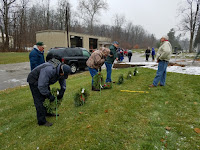
Below are a couple of pictures of the area at the Graceland Cemetery in Sidney where we concentrated our efforts.


Even though this project has been going on for several years across the country, this was the first time for this project in Shelby County, and the first for our group.  There are over 70,000 volunteers who dedicate their day at the National Cemetery at Arlington, Virginia.  Every single grave marker there has a wreath placed on it by the volunteers. 

Below is a picture of Arlington and one of the trucks delivering the wreaths.  Note the volunteers lined up to welcome the trucks.  This is only a small sample of them.  The rest are already at their stations throughout the cemetery.


As I said, this was our first time doing anything like this.  We had no idea what it would be like, what the weather would be, how many people might want to volunteer besides the ones on our committee, what the procedures were for the ceremony, and so on, and so forth.  Lots of unknowns.  But, as we used to say in the MP Corps, "Hope for the Best, Prepare for the Worst."
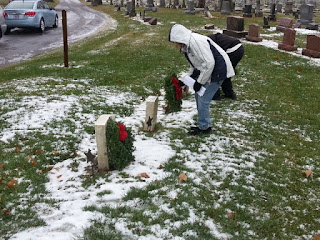

The weather forecasts leading up to the December 17th date were not good.  It called for possibility of snow (10% chance) and freezing rain (90% chance).  We had made arrangements for uniformed personnel from the Piqua and Lima, Ohio Recruiting Commands to assist with the ceremonial wreath paying portion , and we had secured the Honor Guard and Color Guard from the American Legion Post 214 to also assist with the day.  Well, the Recruiters would have had to come from Lima and Piqua, a 30-35 mile drive for both, and the Legion personnel had an average age in the neighborhood of 85 years old.  Some neighborhood! 

Not looking too good for a ceremony.  I walked out of my house at approx. 8:30 just to have a "look-see" and fell right on my backside on the first step off the porch.  Really not looking too good for a ceremony! 

So, not wanting to have anyone get hurt, I called the local radio stations, the Legion, the Recruiters, and the committee members and told them that the ceremony part of the day would be cancelled.   However, I did tell the committee that my wife and I would be at the site at 11:00 to unbox the wreaths and anyone who wanted to try to make it could help us.

It was really rewarding to show up at the cemetery and  see people there already.  Members of the Boy Scouts, Cub Scouts and Girl Scouts were there with their Scout Masters, the Mayor was there and ready to help, some of the uniformed service members showed up anyhow (which really didn't surprise me), and a number of the committee members braved the ice and came down to complete the mission.  What a great bunch of people.
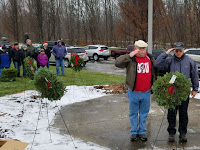


So, we "got 'er done."  Now, we'll meet to have an after action review to document the highs and lows, and the "should-have dones" and the "be sure to remember for next times."  According to the Director of our County Veterans Services Office, there are close to 2,500 Veterans buried in just the Graceland Cemetery alone.  That will be a much larger undertaking for subsequent years.  But we'll start earlier, refine our plans, really push for volunteers...and hope for better weather next year.

There are not words big enough,
There is not a hug strong enough;
There is not a smile wide enough...
All we can offer is our thanks to you.  You are our heroes.
Hooah

Saturday, December 31, 2016

Other things we discovered while there...

We didn't spend all of our time just lying around on the beach while we visited the Outer Banks, even though Pam probably could have just used the whole time walking along the ocean, listening to the surf and watching the birds.  And, in the spirit of fairness, I could have spent lots more time on the golf courses there.  We actually got out and drove around to see what all was there.  I read a review of the area from someone who went there and said there was nothing to do.  Now I know that wasn't true -- I suspect that person just never went out and looked.

One one afternoon, we drove around looking for lighthouses.  I figured since we were near the ocean, and this was, after all the graveyard of the Atlantic, there had to be lighthouses, even if they were not still working or were automated like most of the rest of them around the country.  We were successful in finding several.


 The Bodie lighthouse(right), a horizontally striped one,  was located south of Nag's Head.  We stopped here for a short time, and walked around the grounds.  And even though it doesn't look like it in the picture, just to the right of the scene, there was a severe storm churning out at sea and the winds and rain were making their way toward us.  The rangers closed the lighthouse because the storm appeared to be gaining strength as it came up north, toward the coast.  As it turned out, the whole thing changed course and went back out to sea.  Pranked us.

The other one what we saw, the Currituck Beach Lighthouse (below-right) was pretty cool.  There was a whole village there that has been preserved over the years.  The Currituck area was a private home for one of the very wealthy people of the time.  The whole island area was his private retreat.  At 162' feet tall, the lighthouse's First Order Fresnel light, (the largest size available for American lighthouses), can be seen for 18 nautical miles as the light rotates in 20 second increments.  

This lighthouse stands out for its distinctive red exterior. This design was intentional, to set the Currituck Lighthouse apart from its Outer Banks neighbors.  After completion, the lighthouse was left unpainted, allowing visitors to marvel at the sheer number of bricks involved in its construction.  

The mansion (shown below) was built by Edward Collings Knight Jr. for his wife Marie Louise.  They shared a passion for hunting waterfowl. But in those days, Mrs. Knight wasn’t welcomed in the all-male hunt clubs. Mr. Knight’s answer was to build a 21,000-square-foot “mansion by the sea” just for his bride.  With its bold yellow paint, copper roof and mahogany doors, the Whalehead invites you to explore a fascinating period in Outer Banks history. Nearly every inch of the home has been carefully restored to the way it looked when Edward Collins Knight Jr. and his wife, Marie Louise, first opened the doors as a lavish hunting retreat in 1925.
We did not tour the mansion, but one thing I was told was that the copper roof was used to draw heat and help cool the place.  It also would allow rain water to flow unimpeded into collecting tanks  as that was their source of water for some cooling, household drinking and other requirements.  Evidently, Knight was very much into conservation and the ecology.  I was told that the center chimney was not really a means of letting smoke out of the building.  Rather, it served as a means of letting cool fresh air into the structure as it was drawn in by the flow created through the lower story windows.  There was no air conditioning back then, and the mansions still is not retrofitted for A/C.

Whether it was marveling at the amount of work required to build the Currituck lighthouse, one brick at a time, and my losing count after about ten rounds of bricklaying, or trying to figure out the aerodynamic flow of air and heat through the Knight's mansion, I came away convinced that there were some pretty amazing and industrious people in this country in the old days.With crude tools and methods, lots of sweat and muscle, and NO computers to fall back on, they built this country and made it a truly GREAT place.

Whoever wrote the bad review of the OBX must not have made their way over here.

Men, great and small, must act like the lighthouse; they must shine day and night for the goodness of everyone.  They must take their light, no matter how bright, and reach out into the darkness in search of those who need help.
 Hooah

Tuesday, December 20, 2016

What a strange place for a state highway...

I have to admit...this was our first trip to the Outer Banks and we really didn't know where to go and what were the fun things to do.  So we thumbed through a AAA tour book and came up with some things.  We also asked some people who had gone there before what they enjoyed and what they would pass on if they were to go again.

One of the attractions that came up several times in conversations with seasoned veterans was the trip up Route 12.  OK.  I just drove several hundred miles and now they wanted me to take a ride up some stupid old state route?  Probably a curvy, two-laned thing.  They said we would get to see Duck and wild horses.  OK, ducks and wild horses.  What was the big deal with that.

As it turns out, Duck is the name of a really cool town...ritzy, but nice.  And the wild horses are truly wild, they roam freely throughout the dunes area, are protected by law and date back to the Spanish explorers who came to that area.  That was the big deal with those two things, and I'll write about them later.  But the trip up Route 12 (Ocean Trail) was fun.  We read all the warnings about driving anything other than a heavy duty 4-wheel-drive Jeep out there.  The road went through the town of Duck and through a gate and onto the beach.  In fact, it was sand dunes pretty much all the way up to Virginia.  People lived out there and had to drive this sand beach road any time they wanted to go to town, go to the grocery store or, as often was the case, to evacuate the area due to storms.I bet this was pretty tricky at times.  The sand was pretty deep and soft in lots of places and cars would tent to bottom out and get stuck quite a bit.  Our understanding from those who have been there before is that it can cost up to $400 to get pulled out by the tow truck guys who are parked all along the route, sipping a cool one or working on their tans while they wait for tourists to get bogged down.  The two pictures shown above give you an idea of what the road looked like at the beginning, just as you come through the gate that marks the edge of the town of Duck.  It didn't look too bad -- real hard sand.  That quickly changed.
Another thing that stood out when you started down Route 12 -- the fence marking the end of the sand portion of Route 12, which also served as the end of the wildlife preserve, ran out a long ways into the ocean.  That was to keep the wild horses from getting out of their area and into the civilized world.

Even though I have a Jeep (a Grand Cherokee, not a Wrangler) , I was not going to drive it out in the sand dunes.  I used to do that in the Army and remember getting a lot of sand in the universal joint areas as well as the brakes and wheel joints.  Enough of that and you can really screw up your vehicle.
These kinds of Jeeps were made for this kind of "on-roading."  This particular day was a beautiful, sun-filled, slightly breezy chamber of commerce afternoon.  These vehicles are technically parked in the median.  To their front is the beach and the road is to the rear.  It is like this practically every foot of the way to Virginia.

Imagine driving down a road with this view out the front, and the sides.  This really is a two-lane road, but it's anyone's guess as to where the lanes are.  Rule of the road -- just keep it off the grassy banks and out of the deep water.
Oh, yeah, so how did we get down this road?  We were on a tour, heading down to see the wild horses.  The vehicle we were on was a kinda African safari-looking thing.  A couple of times the driver hit some sand ruts and nearly threw everyone out of the back end of the vehicle.  Kinda reminded me of being bounced around in the back of a "deuce-and-a-half" back in the early days of the Army.

Wonder what kind of maintenance they have to do on that road, if any.  Wonder how much different this road is at night --  in the really, really dark.  This is not a Sunday afternoon drive -- this is more like a commitment.

Just because someone isn't on the same road as you doesn't mean he is lost.
Hooah
Just because they're not on your road doesn't mean they've gotten lost
Read more at: https://www.brainyquote.com/quotes/quotes/h/hjacksonb101503.html?src=t_road
Just because they're not on your road doesn't mean they've gotten lost
Read more at: https://www.brainyquote.com/quotes/quotes/h/hjacksonb101503.html?src=t_road

Monday, December 19, 2016

Kitty Hawk...

A long time ago, I wrote a lot of articles about my flying days.  Those times were right up there with the most challenging and exciting events of my life.  I am still a little bitter about having that taken away from me by the government, but every once in a while I get together with one of my friends from the pilot's club and we "go out" for a spin.  I guess what Sam doesn't know won't hurt him.

Anyway, Pam and I had the opportunity to take a trip to the Outer Banks area of North Carolina this past summer.  I know -- that has been a while ago and I'm just now getting around to writing about it.  I find I do my best golfing in temps above 45 and my best writing at temps below that.  BTW -- it's minus 1 degree outside now. There are lots of really great things to write about, but I wanted to start out with our visit to the Kitty Hawk area where the Wright Brothers first flew their plane.  There are lots of excellent exhibits and plenty of historical sights laying out what must have been an awesome time to live.  There are also plenty of displays that chronicle the written history of their work.  Probably much more than most people would want to take the time to read.

This plaque in the huge rock marked the spot where the first flight took place, going from there to  the first rock on that flight, the second rock on the second flight, and the third rock on the third and longest flight.  I do not recall if the small rail located to the right of the rock is the actual rail used in conjunction with the flight or if it is merely a visual aid.

The weather didn't hold allowing them to do much more beyond that, but their theory had been proven.  Powered flight was now a reality.

On the grounds there is also a mock-up of the work shop/shed where they supposedly did lots of work on the plane's parts, and supposedly parked things when they needed to get them in , out of the elements.  There were a lot of visitors there that day and since there was no Ranger around to watch the sheds, all the little kids felt they had to run around inside them.Not so sure I would have wanted my kids running around inside them.

Again, having been a pilot, I was pretty much into this place and what was done here.  But by itself, this wouldn't even begin to show the brilliance of these two brothers from Dayton, Ohio.  To get a better glimpse into the history of flying, people need to visit the Air Force Museum at Wright Patterson AFB, which is located in Dayton, OH.  Ironic. What they need to do here at Kitty Hawk is come up with some sort of time travel machine that would take visitors back and forth between Dayton and Kitty Hawk.  It is truly incredible to see the rapid advancement of aviation that took place after the Wright's flight of December 17, 1903.

Oh, and one other thing -- I don't know why it struck me as such a revelation, but there is a small airfield (NR01 is the field identifier.  Elevation is only 10' ASL - estimated)  there on the grounds.  When Pam and I were out on the  beach, I would see the typical tourist thing of an airplane flying over the beach, towing a banner advertising eating establishments, etc. But I never knew where they came from.  Now I know.

I would have loved to have been able to take the controls of one of their Cessna's and flown on the same grounds as the Wrights, the place where it all began.
Again, this was just one part of our vacation trip to the Outer Banks (a.k.a. "OBX"), but for me it was like going back to my favorite malt shop in Zanesville where I grew up.  I kinda think I knew what took place there and kinda remember what it all led to, but it was so much fun to see it.

When once you have tasted flight, you will forever walk the earth with your eyes turned skyward, for there you have been, and there you will always long to return.  (Leonardo Da Vinci) 

Hooah